%20(300%20x%20175%20px).png)
You're One Step Away from a Yoga Practice That Actually Transforms You…
Or so you thought. You started this journey because you needed something just for you, something you could call your own. Yet here you are, rolling up your mat for the third time this week, and instead of feeling relaxed and rejuvenated, you have already jumped right back into the laundry list of things waiting for you. The short-lived wave of calm shifts back into chaos mode the second you pick up your phone to find 50 missed messages in the 30 minutes you were on your mat.
You begin to wonder what the point is. Why are you even doing this? Is it worth it? While your mind debates your choice to practice, you also wonder why everyone else seems so connected after theirs. Why everyone else is glowing, talking about how amazing they feel and how that feeling carries them through the entire day. "Why does this work for everyone else but me?" you think, as you set your phone down and head toward the kitchen where a pile of dishes is waiting. You sigh. Maybe tomorrow's practice will be different. At least you have not thrown in the towel yet.
You have followed all the advice. You set up a dedicated space in your home, nothing grandiose, but it works. A small corner next to your bed with your diffuser, your oils, your Spotify playlist ready to go, and your mat rolled out right where you can see it. You subscribed to your favorite online yoga studio, and it is bookmarked on your laptop for easy access. It is written in your calendar, 7:30 AM, after the kids leave for school and before the workday begins and things get crazy. It took you a while to find this groove, and you are proud of that. But something is still not clicking. It is just not giving you that boost, that feeling of "now I can take on the day," and you cannot figure out why. You think, “Maybe I just need to take classes at a studio, the serenity, the time away…” but then you stop. “Ugh, just the thought of getting up at 5 AM or worse, trying to get away after the kids are home and everything is running amok… that just sounds too stressful.” But you love your little home practice, and it is already routine. Why mess that up? You scratch that off the idea list. So now what?

What if it is not the setup, the perfect practice, getting to a studio, or the time of day that is missing? What if the one piece that changes everything has nothing to do with what you do on your mat, but rather what happens just before and just after? That is what this post is going to share with you. The deeper side of yoga that nobody really talks about. We all know the poses. We all know how to create a space that feels good. But what most of us do not know is how to actually connect ourselves to all of it. This one simple and wildly undervalued step is what takes you from doing yoga as an isolated practice to living it in your everyday life. It takes no more than five minutes total, and all you need is a pen and a piece of paper.
When Yoga Ends at the Edge of Your Mat:
Your time on the mat is valuable, and you know this, so why does that feeling not follow you once you have rolled it up for the day? The answer lies in what you do before and after your practice. Right now, you are simply going through the motions. You sit down, press play, the class starts, you move through the poses, maybe you feel something shift or the instructor says something that lands, but you keep going. You take savasana, maybe, and then you roll up your mat and move on with your day.
This is not your fault. If you practiced at a studio, it would be no different. You would arrive, roll out your mat, wait for class to begin, practice, and then leave. Regardless of where you practice, the process is exactly the same. For some people, that is enough. But for a lot of people, it is not. They are craving depth because everything else around them already feels surface level, and they came to yoga looking for something more.
This is where a pen and paper make all the difference. Not the blocks, not the strap, not the perfectly curated space. It is this one simple tool that shifts your practice from something you do to something you actually live. Journaling is what begins to connect the pieces. It builds the awareness that does not just exist on your mat but carries into your morning, your afternoon, and the quiet moments in between. There are three key reasons why this is the piece you have been missing and why it is going to completely change how you feel long after your practice has ended.
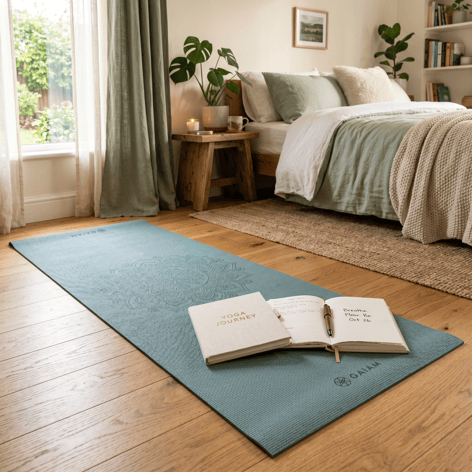
Most people step onto their mat carrying everything they just walked away from, and that is exactly the problem. Journaling creates intention and primes your brain to be present. When you write down an intention before your practice, you are doing more than just jotting down a thought. You are activating the prefrontal cortex, the part of the brain responsible for focus, decision-making, and purposeful action. Research in neuroscience shows that when we set a written intention, we are essentially telling our brain what to pay attention to, which triggers the reticular activating system (RAS) to filter for experiences that align with that intention. In simple terms, you get more out of your practice because your brain is actually looking for it. Without that moment of intention setting, the mind tends to stay in default mode, replaying the to-do list, the missed messages, the pile of dishes, all the things that pull you out of the present moment and keep your practice feeling surface level. Step 1. Use your paper and pen to set an intention, something to anchor you and give you something to pay attention to.
The shift you feel at the end of your practice is real, and if you really want it to stick and recall it throughout the day, it requires you to give that feeling a place to land. Journaling after practice helps your brain consolidate the experience. Writing about your experience activates the hippocampus, the brain's memory center, and helps move what happened from short-term awareness into longer-term memory. Studies on expressive writing show that reflecting on an emotional or physical experience shortly after it happens strengthens the neural pathways associated with that experience. Over time, this means your brain begins to associate your mat with those good feelings more deeply and more reliably, which makes you want to return to it. You are essentially training your brain to crave the practice. Step 2. Use your paper and pen to jot down what went well for you, what progress you made, and where you would like to see growth. This gives you something to come back to each time you practice.
So much of what yoga gives you happens beneath the surface, and without this last piece, most of it goes completely unnoticed. We are surrounded by noise. Even when the house is quiet, there is noise. Things need to be done. Conversations from the past get rehashed in your mind. It is never actually quiet. This is why, without journaling, the full-day benefits get lost in the shuffle. When you journal immediately after practice, you are essentially extending and anchoring that parasympathetic state rather than letting it evaporate the moment you pick up your phone. This is why the feeling can carry into your day rather than disappearing at the edge of your mat. The two practices together create a feedback loop that, over time, rewires how your body and mind respond to stress in everyday life. Without this bridge, your practice stays contained to the 30 minutes you were on your mat. With it, yoga stops being something you do and starts becoming something you embody. Step 3. Ask yourself what you want to carry with you through the course of the day. This goes back to the first step. Just as you set an intention for your practice, this step sets an intention for your day, something to anchor you.
Three simple steps, two and a half minutes before your practice and two and a half minutes after, and what you do on your mat begins to follow you into the rest of your day. Intention before, reflection after, and a single thought to carry forward. That is it. No complicated routine, no extra equipment, nothing that requires more time than you already have. What these three steps do together is create a loop, a conversation between you and your practice that builds over time into something that actually feels like yours. And the more you show up for that conversation, the more your practice shows up for you. Now that you know the why behind journaling, the next step is knowing exactly what to write and how to make this simple habit stick so that it becomes as natural as rolling out your mat in the first place.
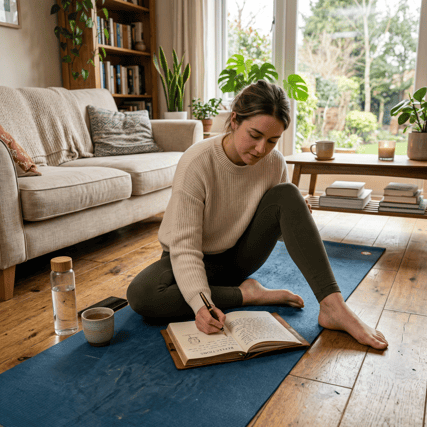
How to Journal Before and After Your Practice Even When You Do Not Know What You Are Feeling
Three simple steps sound easy enough until you actually sit down to do it. I know because when I started this process myself, I sat in front of a blank page for a good 15 minutes with absolutely no idea where to begin. This section is going to save you that time. We are breaking down exactly what to write and when so that you can skip the awkward blank page moment entirely and get straight to the part where this actually starts working for you.
Let's keep this as simple as possible. Grab your journal or a piece of paper and a pen, roll out your mat, and place your notes on it. Sit down. Before you press play, take one deep breath in and a long clearing breath out. Now use one of these prompts to set your intention. You can use all three or just pick one. You are not writing a novel. You are simply bringing your attention to the present moment.
Before Practice
1. What am I bringing to the mat that I want to release?
2. What is one thing I want to focus on during my practice today?
3. What am I feeling right now before I even begin?
Set your notes to the side and start your practice. When you finish, before you even think about standing up, pick your notes back up and answer one question from each of the following sections.
After Practice
1. What was I able to release and how does that feel?
2. Was I able to stay focused during my practice, and if not, what pulled me away?
3. What has shifted now that I have taken this time for myself?
Intention for the Day
1. What feeling do I want to carry with me as I move into my day?
2. What will help me feel supported between now and tonight?
3. What is one word or phrase I want to keep close that reminds me of how I feel right now?
Once you have answered those questions, take one more full deep breath in and a slow exhale out. Roll up your mat, put your notes somewhere safe, and move into your day. Every time you come back to your practice, follow these same steps:
1. Grab your notebook or paper and something to write with
2. Roll out your mat
3. Sit down and take a deep breath
4. Use one prompt to set your intention before practice, one to two sentences are all you need
5. Practice
6. At the end, grab your notes and answer one after-practice question and one intention-for-the-day question
7. Take a deep breath
8. Roll up your mat, put your notes somewhere safe, and go about your day
That is, it. What I love about this method from start to finish is that every single part of it is intentional. It sets you up before you ever take your first breath on the mat and carries you forward long after you have rolled it back up. It also gives you something to return to, a record of your progress, your patterns, and your growth. You can look back and see how you felt six weeks ago compared to today, what has shifted, what you have released, and what you are still working through. All of that awareness is what fuels growth, not just in your yoga practice but in your life. And when you start taking what you discover on your mat and applying it to how you move through your day, that is when the transformation becomes real. Not just moving your body for the sake of it, but shifting your energy, changing your perspective, and showing up differently in ways you never knew were possible.
Two Tools, Five Minutes & A Practice That Finally Feels Like Yours
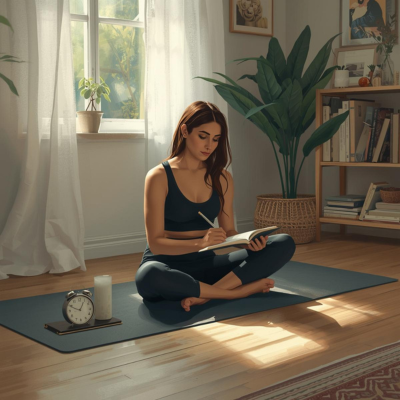
This was never about needing more time, a better setup, or a different class. You already had everything you needed; you just needed a way to stay connected to it. Five minutes, a pen, and a few intentional thoughts can turn your practice into something that actually follows you into your day. That is where the shift happens. That is where yoga begins to feel like it is truly yours. And if you would rather not think about what to write or how to structure it, Practice, Reflect, Evolve: A Yoga Journal for Daily Awareness was designed from my own need to make this easier. To have something simple to reach for without overthinking it, especially on the days when my mind feels full and scattered. It is a gentle guide you can open and come back to again and again, so you can spend less time wondering what to do and more time actually feeling the impact of your practice. You can find it on Amazon or Barnes & Noble feel free to go check it out! When yoga and journaling work together, your practice no longer ends at the edge of your mat, it becomes something that supports, grounds, and transforms you long after.
Leave Your Comment
All Comment will be Monitored for Appropriateness. Thank you!