-1.png)
Why You Leave Your Yoga Practice Still Carrying the Same Weight:
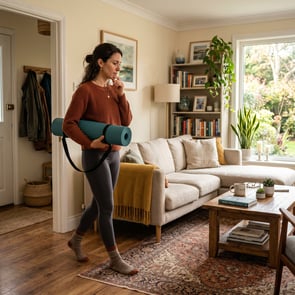
You roll out your yoga mat. It's been a long day, and you are really hoping to shift your energy by doing something for yourself. The kids are in bed and you set up your essential oils with lavender and chamomile to help you settle and relax. Your computer is propped up on the end table and your favorite yoga teacher has just uploaded a new practice to the platform. You press play and, for the first time all day, you take a deep breath. It feels good. A lot has happened between the time the alarm went off and this moment right here.
Thirty minutes later, you roll out of savasana and some of the weight of the day has lifted. You feel a little lighter. The laundry has been folded, the dishes are in the dishwasher, and the only thing left to do is get ready for bed. Just as you are about to turn off the lights, your phone pings. You pick it up, even though you know it could wait until morning, but you look anyway. A bold caps email from your boss, three emails from three different teachers for three different kids, a text from your sister, and then you hear something coming from the kitchen. You walk in to find the lights on and your oldest rummaging through the food cupboard for a late night snack, complaining they are starving. You shoo them back to bed with a glass of water, and as for the notifications, it's too late to do anything about them now, so you'll deal with it in the morning.
That brief moment of relief has now been replaced by the same weight you were carrying all day, and that's how you climb into bed. As you lie there, trying hard not to respond to texts and emails, you ask yourself: why won't that feeling of relief that washes over me during practice just stay with me? Why does it seem to disappear the moment I walk into another room or pick up my phone? Everyone says they feel more calm and regulated throughout the day when they practice yoga, so why don't I get that same benefit? Too tired to think any longer, you close your eyes and go to sleep.
If this is the cycle you experience with your yoga practice, you are not alone, and it is actually very common. Before we break things down and I show you how to decode what your body is telling you so that you can tap into lasting practice benefits, here is what you need to know: even though your results are short lived, the practice is still working. You are not practicing wrong and you do not need to practice more. It's deeper than that. Think about the last time you had a conversation where you walked away feeling misunderstood, unheard, or worse, completely ignored. What did that feel like on the inside? Disconnected? Like there was a gap between what was said and what was meant? Maybe it even felt a little frustrating. Just like a conversation that goes ignored, your yoga practice cannot help you if you are not truly listening to what your body is telling you while you move and breathe on the mat. The shift is happening. You just have not listened close enough yet to have it make a difference.
The Conversation Happening Inside Every Practice
The practice of yoga is more like a deep conversation between two close friends, yet most classes and practices are treated like a performance. We focus our attention on what the poses look like. We compare our bodies and how we create the shape to others in the class, to the instructor, to what we have seen on social media. But the truth is, none of these things truly matter. When we treat our practice like a performance, something we just do because that is what we are told to do, it becomes very similar to a one-sided conversation that feels more like a list of demands rather than two people equally sharing ideas, listening to each other, and applying what they hear in a meaningful way. That exchange is ultimately what we want our yoga practice to become.
Each time you step on your mat, you are sitting down to coffee with your best friend, you, and it is vital to that friendship that you tune in and give yourself the full attention you would want to receive. The only way to do this is to let go of the external shell of the practice, stop performing the poses, and start feeling them. Immerse yourself in a conversation you are deeply connected to and be ready, no matter what comes up, to face it with grace and acceptance. This is not easy to do, because when we take classes either in a studio or online, we are taught the performance aspect of yoga. Emphasis is placed on alignment and placement of the body in space. It is a very visual practice, and what we see is where we unintentionally place our attention. It is like talking to someone who is making eye contact with you but you can feel they are not mentally present. They hear you, but they do not feel the magnitude of what you are saying.
To begin shifting from performing to being, from hearing to listening, start simply by noticing when you want to override a feeling. Take chair pose, Utkatasana, for example. This fiery pose strengthens the legs, the core, and the glutes. From the moment you bend your knees and sit back into your heels, you feel heat building, muscles shaking, sweat forming around your temples. What is your initial response? Do you cheat yourself by letting up and giving it only half the effort? Do you fixate on how much your legs are burning? Maybe you start wondering how much longer the teacher is going to hold this pose. Maybe you turn on yourself with language like, don't be so weak, why did you let yourself go, you are so pathetic you can't even hold this. All of that is your attempt to override your body's signals. You stop listening and start talking louder so you don't have to hear what is being said, because it is not what you expected to hear.
When you begin to pay attention to what is actually being said, your yoga practice stops competing to be heard. The first step in decoding your body's signals is to become the observer. To simply notice the patterns of your breathing and the resistance, physical and emotional, moving with or against you. The performance will only take you so far. Chair pose is trying to teach you something, and if you are too busy overriding the signal, looking at the pose instead of feeling it, nothing that happens on the mat will ever translate beyond it.
From Noticing to Understanding: Catching Yourself in the Pattern
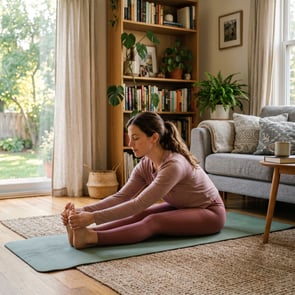
Think back to when you first unrolled your mat and the process it took to build a consistent yoga practice. Maybe the first few weeks you were touch and go. Some days you let it slide, other days you were all in. Over time you started to notice patterns in your behavior, and because your goal was consistency, you had to become aware of what in your daily routine was holding you back from making that happen.
Maybe the time of day was the issue. Maybe getting to a studio was too hectic and you kept skipping. Whatever the pattern was, eventually you made the choice to be more intentional. Maybe that meant starting a home practice, changing the style of yoga, or shifting the time of day. Once you identified what was hindering you, you took the steps to work around it and created a more workable path. That same process can be applied to learning how to stop overriding your body's signals, so that you can connect to your practice on a deeper level and have it available to you not just when you are on the mat, but when you truly need it most.
If you can observe one pattern, you can find others. The next one to start noticing is your tendency to override the signals your body is trying to send you. This can look like restricting your breath in a challenging pose. Does your breathing get choppy and shallow when things get hard? That is avoidance. I like to think of it like a little kid who closes their eyes thinking that if they don't look at something unpleasant, it will go away. But when they open their eyes, it is still there. Holding your breath is not going to make the pose go away. The same goes for when your mind starts racing and pulls you out of the present moment. That is the "if I just don't think about it, it will fade into the background" response. The reality is that turning your back only prolongs the inevitable. It gets buried for a while, but it will resurface.
The key to this observer step is to take a third person approach, looking at yourself from the outside in. Remember that coffee date where you are sitting across from yourself. You are your own best friend. Would you tell her to ignore an important message she is afraid to hear? Would you judge her and tell her she is a bad person? Hopefully the answer to both of those is no. You are simply watching for patterns, not giving advice or offering opinions. No stories, no judgment. Just follow the pattern. Once you find it, whether it is avoidance, rushing through, or checking out entirely, acknowledge it, give yourself some grace, and choose to move through it.
Each time you find yourself slipping back into old habits, whether that is making a mental to do list in savasana because you can feel yourself itching to roll up the mat and be done, or belittling yourself for wobbling in tree pose, instead of muscling through, practice being present with every thought and sensation through the eye of the observer. The more you do this, the easier it becomes, and it will set you up for everything we are moving into next as we go deeper into the conversation with your practice.
The Body Speaks in Feelings: Every Pose Is a Preview
Take a moment to think about a time when you felt really stressed out. What was your reaction? How did your body respond? What did you feel? Stay with me here, I promise it will all connect. When I get stressed, I can feel my heart rate go up, my breathing gets stuck, and my chest tightens. My muscles tense and my instincts tell me it is time to go. I am an avoider. Maybe you are too. Those instincts might help sometimes, but more often they just leave you drained and exhausted, and you chalk it up to just being who you are. Maybe you are not even aware of why you respond the way you do, and that is okay too. Simply giving yourself this moment to take notice is what will make understanding your yoga practice that much easier. Each time you move through a yoga pose, whether it feels easy, hard, or neutral, you are pausing to take inventory. You are previewing your habitual response to all kinds of situations in your life.
Have you ever noticed that some yoga poses feel easy and satisfying? You look forward to them. They bring a sense of joy and contentment. And then there are the poses you dread, the ones you cannot wait to be done with because they trigger a stress response that makes you uncomfortable. That is exactly why I asked you to think about a stressful moment and how you reacted to it, because those same feelings are going to show up on your mat. Your yoga practice is a mirror, a reflection of your daily life. Sometimes things feel good and you wish the feeling would last forever. Other times you face challenges that make you feel uncomfortable and uncertain. Both are part of life, just as both kinds of poses are part of your practice.
This took me a while to see and feel at first, but once I did there was no turning back. It was this realization that allowed me to truly connect to my practice. Think about your least favorite pose. For me it is Utkatasana, chair pose, which is why I keep coming back to it as an example. Even now I do not love it. I tolerate it, I do it, but I do not excitedly wait for it. Think about what happens in your least favorite pose as the instructor cues you through it. For me it was instant panic. My legs shaking, my breath shallow, my heart rate climbing, my mind spinning. Every practice, every time. Then one day, while I was holding chair pose and silently begging for the cue to forward fold, I actually heard something my instructor said, and it changed everything.
She said, right now you have a choice. You can lean in and sit with the discomfort you are feeling, or you can walk away from it. If you stay, you will come to see that all challenges eventually end, and you will know that you had the strength to endure a temporary hardship. If you walk away, you will always wonder what would have happened if you had just stuck it out. One gives you closure, the other leaves you with unanswered questions. Which do you choose? I chose to stay. I closed my eyes, deepened my breath, and just as I started to settle into the discomfort, she cued forward fold. It was done. I made it through.
I stopped avoiding and started listening. My body was telling me that I still had strength left to give. I was tired and sore, but I had more in the tank. The more I practiced this in chair pose, the more something clicked. If chair pose is temporary, and I can quiet myself enough to hear what my body has to say, what would happen if I applied this same approach to other areas of my life? I started small. A long line at the grocery store when I was in a rush. I closed my eyes, took a deep breath, and reminded myself this is not going to make or break my day. Then I applied it to bigger things, like interviewing for a job. Nervous, shaking, mind racing, what if they don't like me, what if someone is more qualified? I took my yoga practice into that interview. Not chair pose in the waiting room, but a breath before walking in, a moment to soften, and a choice to bring my attention back to the present moment.
So the question becomes, what is your chair pose? What does your body do when you get into it? Are you willing to stay and see it through? There is no shame either way, but when you choose to stay, when you choose to listen and give yourself the same care and attention you would give your best friend, you get to understand yourself in a way you never have before. What once felt like a foreign language becomes fluent. What once felt like going through the motions on autopilot starts to feel purposeful and full of meaning.
Building the Habit of Actually Listening
Now that you have the foundation for decoding what your body is telling you through your yoga practice, and you have the basic tools to carry what you feel on the mat into your daily life, it is important to understand that awareness alone is not enough. Just like learning a new language or skill, it must be practiced or it will fade, old habits will creep back in, and the foundation you have been building will not take hold. So how do you keep moving in the right direction? Repetition and reflection. Repetition reinforces the new skill you are trying to evolve into a habit, and reflection helps you commit it to memory. Just like at the grocery store, I had a choice. I could be miserable and impatient, or I could take what I learned on the mat and apply it in that moment. I chose the latter and saved myself energy, time, and frustration. Then at the job interview, when stress showed up again, I reached for that same sense of softness I had practiced in chair pose. But those moments did not happen by accident. Just as you built a structure to help you show up consistently on your mat, you need that same kind of structure for the skill of observing and listening so that it can grow into real understanding.
One of the best ways I have found to do this is to journal. It took me no more than five minutes total and the insights it gave me allowed me to see clearly where and when I was falling back into old patterns. It gave me a place to record my experience with different poses so that I could not just feel the progress I was making but actually see it, because sometimes progress is hard to gauge on your own. It also gave me a place to work through confusion. What I thought was weakness turned out to be exhaustion. What I thought was lack of motivation turned out to be overstimulation. Without this small added piece, going back to moving through the motions would have slowly crept back in and I would have found myself at square one wondering what happened to the practice that once felt so good.
The good news is that this does not have to feel like added work. It is actually very simple. I wrote an entire blog post on this if you want to go deeper, you can check it out here: Want a More Consistent Yoga Practice, Start with a Journal. But here is the short version. Take two and a half minutes before you step on your mat to write down your intention or a feeling you want to embody during your practice. This anchors you in the present and gives you a fresh perspective before you even begin. When you finish, take another two to three minutes before you grab your phone or roll up your mat to write down a few sentences about what you felt, what you observed, or what shifted for you. Then before you close your journal, write down one word or phrase you want to carry with you through the day, something you can reach for when a stressful moment arrives so that you can recall your practice and apply what you learned.
Over time your journal becomes a roadmap. You can return to it again and again to track progress, notice patterns, and find the breakthroughs that remind you to keep going and keep exploring. This last piece is not meant to add more to your plate. It is meant to save you time and give your thoughts and feelings somewhere to land after you step off the mat, so that instead of fading, everything you are building here can take root and grow far beyond your practice and into your everyday life.

Nothing Was Missing, You Just Needed to Learn How to Receive It
At the end of a long day you roll out your yoga mat, kids tucked in bed, essential oils lit, and your favorite instructor just on the other side of the play button. Before you press play, you open your journal and write down your intention. When savasana ends, you reach for your journal again instead of your phone, taking a few quiet moments to write down how you feel and what you want to carry with you. As you roll up your mat, you hear the same footsteps in the kitchen and the same pings on your phone, but this time something is different. You are calmer. You are more aware. You feel the stress rising in your body but it no longer takes hold of you the way it once did. You take a deep breath, patiently send your child back to bed with a glass of water, and leave the emails and texts for the morning because it is late and there is nothing to be done about them now. You get into bed, close your eyes, let your body soften, and sleep soundly.
That is the difference between listening and understanding versus hearing and not really paying attention. You now understand that yoga is not a performance demanding to be watched, but a conversation between you and your best friend, you, and you are fully immersed in it. Instead of going through the motions, you now watch carefully, listen with intention, and understand that what your body is communicating is not just sensation. It is something worth slowing down to explore. You no longer come to your practice chasing a feeling, desperately trying to hold onto a calm that always seemed to slip away. It is yours now. It was always yours. It was just waiting for you to hear it.
That two and a half minutes before and after your practice that I mentioned, I actually created a journal built around exactly that. I wanted something just for my practice and now I want to share that with you. Inside Practice, Reflect, Evolve: you will find prompts that are simple quick and easy to answer. No writers block, no guesswork, because this was never meant to be another thing to add on your to do list. Grab your copy here.
**If you enjoyed this post and found it valuable, I would be so grateful if you would buy me a coffee so that I can continue to create health and wellness posts that inspire, educate and empower women to show up for themselves to live happy, healthy and strong lives.
Leave Your Comment
All comments are read and monitored for appropriateness. Thank you.